
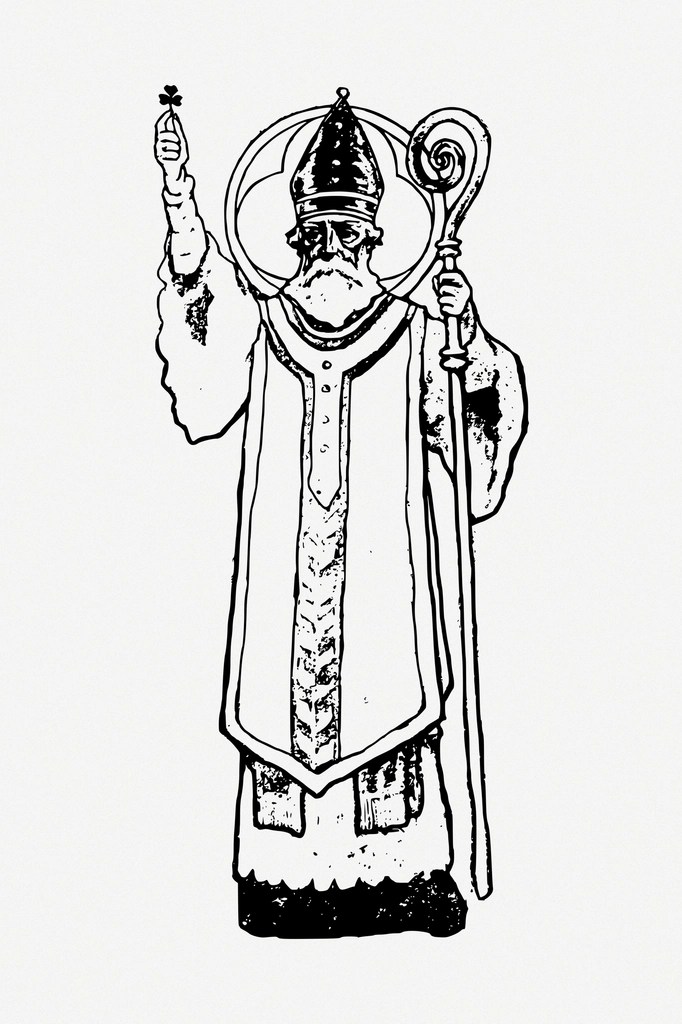
Patrick of Britannia, the famed “saint,” left his home, family, and comforts to live among a hostile people and preach the folly of the cross to them. The Lord called him to be the apostle (in the non-technical sense) to the Irish, and to accomplish the establishment of Christianity in that land. Many people will be celebrating his “feast day” this week, but few know that he was a reverent, holy, and Scripture-saturated gospel preacher. He wasn’t originally respected for his supposed miraculous expulsion of snakes, or for his fiery Irish temperament (he wasn’t Irish), but for his love for the Lord Jesus and people’s souls. He risked everything to bring the riches of the glory of Christ to impoverished sinners under God’s wrath. And because of his sacrifice, many were made rich, and the Lord Jesus was brought honor and worship.
Patrick was simply doing what so many have done down the centuries since the Lord ascended into heaven. Jesus gave His apostles, and all their followers, the commission to “make disciples of all the nations, baptizing them in [lit. “into”] the name of the Father, and the Son, and the Holy Spirit, teaching them to observe all that I have commanded you” (Matt. 28:19-20). From Paul down to the present day, believers of all backgrounds have answered the call to proclaim the riches of Christ to the ignorant and hopeless.
One other notable example of zeal I’d like to showcase is a man who lived several hundred years after st. Patrick. Not only was he an evangelist like the so-called “saint,” but he was one also sent to the Irish. In the midst of a society that retained a mostly empty form of Christianity, the Lord raised up one of the least known giants of the faith in the 19th century. In 1803, a man was born to a wealthy family in Denmark named Robert Chapman. They were native Englishmen, but lived there for the father’s business. This family had all they could wish for, except for eternal life. And Robert Chapman grew up having all the comforts of an elite household, including an excellent and thorough education. He proved himself very intelligent, learning several languages, and then studying to be a lawyer. Yet he wasn’t taught to trust Jesus Christ until twenty years old.
Soon after being saved, Chapman devoured the Scriptures, and almost immediately began sharing the gospel with his family members, friends, and neighbors. Although he was a successful lawyer, the pull to preach the gospel as a full occupation stirred him for months and months. Having come under the mentorship of a godly teacher and preacher, he had also begun to deliver sermons to his assembly.
Within a few years, he was convinced that the Lord had called him to devote his entire life to preaching the gospel and teaching Scripture. Having been influenced by a book written by a prominent leader, he was further persuaded to give up his law practice, use his inheritance to purchase a large home for the use of hospitality, and just rely on the charity of God’s people to support him the rest of his days. He moved to a large manufacturing town called Barnstaple, and there determined to build up a Christian community that would transform the town for decades. Despising his wealthy and learned background, he diligently served, preached to, and taught the most impoverished of his community, winning the souls of many to the Lord. He lived right among them, enjoyed a small living space, and ate the commonest of food. He followed the example of Paul in becoming “all things to all men, so that I may by all means save some.”
His commonality with st. Patrick goes further than both being evangelists and sacrificial leaders, though. He too went to foreign lands to preach the gospel and build up churches, including Ireland itself. His first missionary endeavor was to the nation of Spain, which was held in bondage to the rule of an apostate Catholic Church. He learned through his experiences that many of the Catholic priests in the country openly opposed the spiritual teachings of their Church. So not only was a nominal apostate institution in control of people’s religiosity, but there was also a rampant anti-supernatural and atheistic mood among the people. To preach the gospel openly in the country was a crime in the eyes of both the general populace, as well as the government. It was a hostile society deceived by Catholicism and secularism.
Yet Chapman’s heart, through the Spirit, led him to take a long tour of much of the country by foot. He would walk from town to town, sharing the gospel privately as he went. There were almost no biblical and strong churches in the country, so Chapman was a pioneer to that land. He planted numerous seeds, and saw several professions of faith. And this was only his first visit to the country. He went at least one other time, and the eventual fruit of his labors was evident. Decades afterward, there was a thriving presence of biblical Christians preaching the gospel and teaching disciples.
After going to Spain, however, in 1847, he set his sights on Ireland. Since 1845, the country had been suffering from the famous potato famine, and about 750,000 people had died. Chapman’s assembly partnered with an Anglican church to send donations to some of the orphaned children in the land. But Chapman knew that the country was in deeper bondage than that which starved people physically. They were starved spiritually, and there was a famine in the land for the hearing of the Word of God.
Thus, at the end of the famine, Chapman planned an itinerary with many brethren and like-minded assemblies in Ireland. As he did in Spain, he endeavored to take a long walk across a great swathe of the country, and preach the gospel as he went. And so he did. For several months of 1847, he walked from town to town, visiting churches, and preaching the gospel wherever he could. He was one of the regular open-air evangelists of the 19th century, and so he would use any public space he could that would appropriately attract many people. But he even preached the gospel to those he met on the road.
When he visited towns, he would also attempt to encourage and teach the brethren in Christ there. And he didn’t confine himself to any particular group. He partnered with Anglicans, Methodists, and other Protestant sects. As he did, he would encourage them to preach the gospel, and to help the poor in their communities. Almost by himself, he did a great apostolic-type work in Ireland. Brethren were more united, thousands of unbelievers had learned the gospel, and many people were converted through his preaching and witness to the gospel. The Lord seems to have used him in such a mighty way, that only 11 years afterward, a great revival blazed in Ireland at the end of the 1850s.
So, as we celebrate the legacy and example of saint Patrick, let us remember that he served as a self-sacrificing missionary to bring the gospel to a country that would later be planted by other preachers. All around us, the harvest is ready, but the laborers are few. Therefore, beseech the Lord of the harvest that he will send laborers into his harvest. And if you’re in Christ, you’re a co-laborer in this work spread the gospel in our towns, our regions, and to the peoples who are yet ignorant of the Lord Jesus Messiah. Let us follow the examples of Patrick and Chapman in “striving together for the faith of the gospel,” so that God’s grace will spread to more and more people, as the gospel calls the lost sheep of the house of Israel into the fold of the Shepherd.
 BEARING CHRIST CRUCIFIED AND RISEN