
Why Bible and Theology Teachers Need to Use Questions More
All Scripture quotations are taken from the New American Standard Bible 1995 Ed. (NASB95)
Good questions get good answers. This is a fundamental rule of speech and learning, and yet far too many people neglect it. Oftentimes, we’re afraid to ask things because we don’t want to be considered stupid or rude. But if the question is burning in our minds, our refusal to ask a living person often results in us later asking the all-knowing Internet. But people were made to ask, as well as answer, questions. This is one of the chief ways that we learn, and is usually more beneficial than getting an impersonal machine to spew out the perfect explanation.
Think about the average young child. They are constantly asking questions, so they can understand the world around them. But questioning those who ought to know what we need to learn shouldn’t stop with adulthood. Likewise, our walk with Jesus shouldn’t be a learning journey on which we unquestioningly accept all that we’re taught from Scripture. We should be asking questions until the end of our days on earth, because we should be desiring to continually learn more about what our Lord is doing in our lives.
Recently, I had a brother ask me a ton of questions about what I thought on the subject of church identity and structure. At the end of our conversation, he was expressly grateful for me answering them all. On the other hand, I had another brother recently reply to my invitation for questions that he had many of them, but he expected them to be answered in other contexts. Whether we ask questions immediately, or patiently wait for some of our questions to be answered at more appropriate times, questioning sources of wisdom and knowledge should be a way of life for us.
On the flip side, those who teach others should be good at asking questions too. Because it’s the best questioners who are the best learners. This starts with the teacher’s education, since the process of learning is the answering of questions. However, one of the best, and under-utilized, teaching tools is questioning your students. This is especially true of Bible teachers.
One of the greatest problems with the teaching method of western Christianity is that there’s far too much reliance on the sermonic form, or monologue. In spite of its near-universal practice in western churches, there’s almost no evidence in the New Testament that one-sided speeches were delivered to the early assemblies. On the contrary, there is evidence that the gifted teachers of the congregations taught with a more conversational style.
The ultimate example of this form of teaching is our Lord Jesus Himself. In several of the lessons He gives, He asks questions of his students, expecting an answer from them. We could think of someone like the rich young ruler, or His disciples. But this precedent is set early in His life, when He’s in the temple at twelve years old, and His parents are recorded as having witnessed this:
“Then, after three days they found Him in the temple, sitting in the midst of the teachers [of the Law], both listening to them and asking them questions. And all who heard Him were amazed at His understanding and His answers.” – Lk. 2:46-47
This is an apparently puzzling passage, since it says that Jesus was “asking them questions,” but then concludes that the people hearing Him were amazed at “His answers.” There’s only one logical explanation for the questions He was asking. He wasn’t asking questions from ignorance, but questions designed to answer what the teachers were teaching. In other words, he was teaching the teachers by asking them questions about what they were saying!
Another great example of someone who taught by asking questions is the apostle Paul. In the Book of Acts, Luke records this about one of his teaching sessions:
“. . . when we were gathered together to break bread, Paul began talking to them . . . and he prolonged his message until midnight . . . When he had gone back up and had broken the bread and eaten, he talked with them a long while until daybreak, and then left.” – Acts 20:7, 11
The significance of this passage lies in the specific Greek words that Luke uses to describe Paul’s speaking. The first is dialegomai, which literally means “dialogue,” or “double word.” So he’s talking about a two-way exchange, not a one-sided speech! Along the same lines, the second word translated “talked with them” is homileo, from which we get “homily.” However, far from being a monologue, this word literally means “to associate with,” or “to be in company with.” In Luke 24:14, 24:15, and Acts 24:26, Luke uses a form of this word to convey people having a conversation. So far from delivering a lecture or sermon to these brethren, Paul was talking with them. And if you know how to have a good conversation, especially when teaching, you know that this requires you to ask questions.
You find convincing evidence for Paul’s style of conversational teaching in his Letter to the Romans. Throughout it, and especially in the first few chapters, he’s constantly asking questions. And these aren’t just questions where the answer is obvious, and immaterial. The reason he asks them is so he’ll provoke an answer from his audience. Here’s a sample of several of them:
“You who preach that one shall not steal, do you steal?” – 2:21
“So if the uncircumcised man keeps the requirements of the Law, will not his uncircumcision be regarded as circumcision?” – 2:26
“Then what advantage has the Jew?” – 3:1
“What then shall we say that Abraham, our forefather according to the flesh, has found?” – 4:1
“Therefore what benefit were you then deriving from the things of which you are now ashamed?” – 6:21
I think you see the point. Paul was a question-teacher, and he’s one of the best examples we have, since he wrote most of the New Testament. It’s a wonder that Bible teachers don’t more closely follow his example.
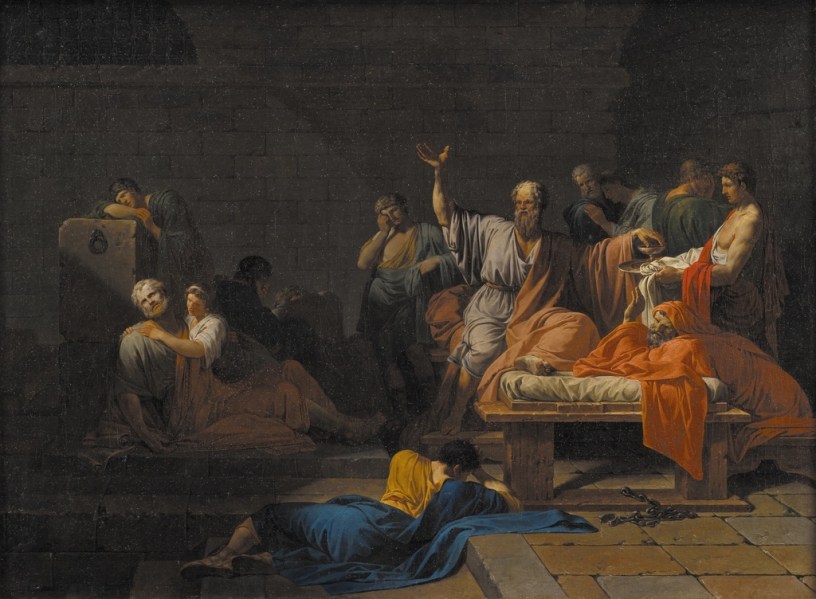
Aside from our biblical examples of question-teachers, we could also think of the paragon of philosophy, Socrates. Have you ever heard of “the Socratic teaching method”? This is his tactic of attempting to draw knowledge out of his students by asking them questions. Now, he may have been terribly wrong in his presuppositions for teaching, since it’s possible that he and his followers thought that people inherently have the answers inside their heads. This obviously isn’t the case. But it doesn’t nullify the fact that leading people to understanding by asking them to think about the subject themselves is extremely effective.
In fact, I’ve heard numerous testimonies to the fact that people usually learn better in a smaller setting, where the teacher is asking them to consider the subjects he’s attempting to teach them. That’s why many biblical studies and theology books today usually contain “study questions” at the end of major sections. That’s also why from the early days of the body of Christ, Christians have used “catechisms,” which are teaching guides set in “question and answer” form. One of the most famous is the Westminster Shorter Catechism for the Westminster Confession of Faith, but there are numerous others.
In spite of the examples for, and evidence that, teaching with answer-seeking questions is one of the best educational methods, why do we insist on relying on sermons? I admit that in some contexts, it’s impractical and ineffective to ask complex questions of an audience, expecting an answer. This is clearly the case when you have hundreds of people listening. But what about smaller congregations, and Bible and theology classes? I believe there needs to be a rethinking of the way most western assemblies teach the Bible, and a rethinking of the best ways to communicate and educate believers. We ought to be more devoted to following the examples of our Master, and of the New Testament apostles like Paul. They clearly didn’t think that it was too personal, informal, or difficult to engage their students with questions for which they expected answers. They weren’t professors giving lectures, or orators presenting speeches, but shepherd-teachers explaining the glorious works and instructions of God to their brethren. May all who seek to teach the Word do the same. This will greatly help us to equip Christians to bear the message of Christ and Him crucified.
 BEARING CHRIST CRUCIFIED AND RISEN