
All Scripture quotations are taken from the New American Standard Bible 1995 Ed. (NASB95)
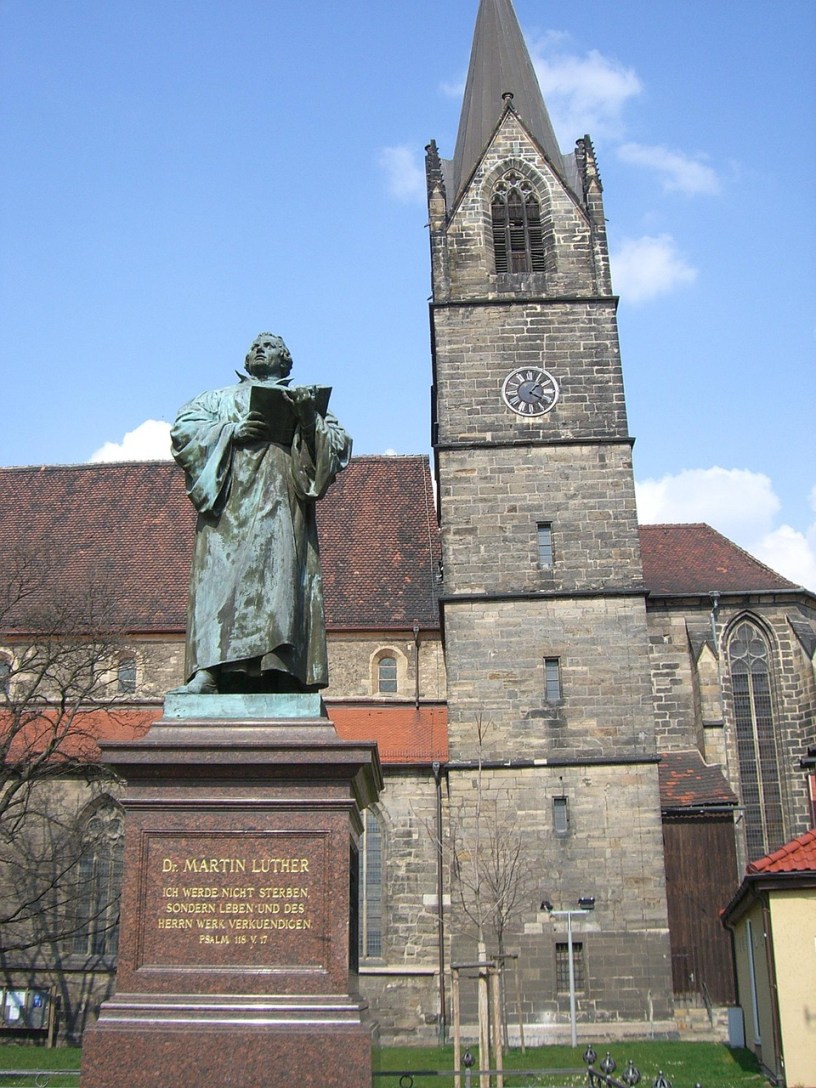
If you know the story of Martin Luther and the beginning of his reformation of the German Catholic church (1517), you know that his discovery of the biblical gospel came about from an intense examination of the Scriptures. He recounted that he spent hours and probably days (and perhaps weeks) attempting to understand one verse of Scripture – “for in it [the gospel] the righteousness of God is revealed from faith to faith; as it is written, ‘The righteous man shall live by faith’” (Rom. 1:17). He described the way he came to see the truth of salvation it revealed as though he were striking a rock that contained a precious commodity. Think of Moses striking the rock in the wilderness so that water gushed forth. But it was a strenuous, taxing, and exhausting exercise of going over the words again and again in his mind.
“‘The righteousness of God’ – what does this mean? How can the gospel be the power of God for salvation if this righteousness of justice and holiness is revealed? That righteousness which condemns and damns me to hell because of my incessant unrighteousness could not possibly be what is revealed in something that Paul calls “good news”” (gospel)! Thus, Luther was forced to acknowledge the true meaning of Paul’s words. He wasn’t describing a righteousness that Luther had always assumed was exclusively used by Scripture, but the righteousness of God demonstrated in His act of declaring or pronouncing a sinner to be righteous in His sight, simply through faith. This could be the only meaning of Paul’s words.
He famously said that it was as though “the doors of paradise were swung wide open,” for he now understood that for him to live as a “just” or “righteous man,” all he needed was to put his faith in God’s promise to justify the ungodly based only on Jesus’s satisfaction of God’s righteousness on his behalf. And from that point forward, Luther began preaching the true, apostolic, good news of forgiveness and justification through faith alone in Christ alone for God’s glory alone.
This momentous example of meditation and insight given to the first lastingly successful Reformer shows us how wrong we can be about our understanding of Scripture, how difficult and time-consuming learning it can be, and how our lives can be shakingly transformed, resulting in turning-points in whole societies. For further context, note that Luther was an expert biblical scholar, and had been studying the Scriptures for several years in the original languages, along with the church fathers, such as the insightful Augustine. So it wasn’t until the Holy Spirit had opened Luther’s mind to understand the Scriptures through the means of his earnest searching for truth that he grasped Paul’s and the apostles’ meaning of God’s righteousness in Romans.
How many essential biblical terms and concepts do you think we are misunderstanding due to our unbiblical traditions and educations, and that we continually use to misinterpret the Scriptures? For Luther, his misunderstanding made his life a hellish and hopeless torture of striving to satisfy God’s righteous demand for moral goodness and uprightness. I am sure many of us are suffering great misery and failure in our Christian lives because of similar misunderstandings of Scripture. Yet we’ve never seen our erroneous beliefs about Scripture’s teachings, because we’ve never taken adequate time and pains to study the relevant passages in their context.
Reformation Requires a Renewal of Meditation
I’ve been thinking and writing about biblical reformation of the American part of Christ’s body on earth in remembrance of Luther’s famous October 31st declaration of protest against Catholic abuses. One key to his reformation was his meditation on Scripture.
In case you’re unfamiliar with the biblical use of the word, “meditation,” let me just cite two landmark examples from Scripture. In Psalm 1, David writes of the “blessed man” as the one whose “delight is in the law of the LORD, And in His law he meditates day and night” (v. 2). In Psalm 119, he likewise exclaims,
“O how I love Your law! It is my meditation all the day.” (v. 97)
From these passages, we can learn that the “meditation” of a believer can’t be an emptying of your mind of all thoughts, but rather a filling of the mind with thoughts about God’s “law,” or “teaching”. And notice that David’s habit was to meditate on the teaching of God constantly. He sought to regularly remember and converse with what God had revealed to him about His will and character.
Paul says a similar thing in his letter to the Philippians, where he gives one of the most succinct calls for meditation in Scripture:
“Finally, brethren, whatever is true, whatever is honorable, whatever is right, whatever is pure, whatever is lovely, whatever is of good repute, if there is any excellence and if anything worthy of praise, dwell on these things.” (Phil. 4:8)
Where else are things and concepts with these qualities found in such fullness and purity except for the Scriptures? Hence, it’s a divine requirement that believers engage their minds with the examination of, pondering on, and reverent questioning of God’s Word. Why is this so important? Paul himself gives the answer in the verse right after this one:
“The things you have learned and received and heard and seen in me, practice these things, and the God of peace will be with you.” (Phil. 4:9)
Clearly, the things that the Philippians “learned and received and heard” were the truths and wisdom found in the Scriptures, and those were the things they were to “practice,” so that God would be with them.
We see from these passages that the Lord expects His people to regularly, consistently, and increasingly think upon the Scriptures, so that they’re better able to put their teachings into practice, for the glory and praise of God. But more than this, if we want to experience the revival and reformation of our lives and our churches, meditation on the Word will be an essential means to those ends.
If we want to discover our great defects, deceptions, distractions, and disorders, then it will require us to read, study, remember, and ruminate on the holy Scriptures daily and constantly. Like Luther, you will likely find that you’ve been believing things about Scripture’s teaching that is foreign to its true meaning, and doing things that are inconsistent with it. The question is, do you have such a love for the Lord that you are willing to put the time and effort in to prayerfully examine His Word, and learn its meanings and applications for your life?
Even if you read your Bible every single day, most of the time you will hardly profit with encouragement, mind-change, and comfort if you neglect to meditate on it. So in order to encourage you, and give you suggestions and tips for engaging in this wonderful discipline, let me give you some general guidelines for thinking deeply about the Scriptures, so that you’ll truly learn their content and implications for your life.
How to Meditate on Scripture
- Set aside a designated block of time, ideally in the morning, that will be devoted solely to Bible reading and meditation for the day. Set aside all avoidable distractions!
This time period should be long enough for you to read a large section of Scripture at least twice, to learn its basic meaning, and to pray about its meanings for your life. That probably means at least 15 minutes.
2. Choose a section of Scripture that you think will be especially relevant to your situation for you to truly learn.
Again, this should be a lengthy portion, such as a chapter, large series of chapters, or an entire book. It should be lengthy so that you can see the general context of the passage, and then focus in on a smaller part for meditation.
3. Read a Bible passage at least twice (after praying for understanding, of course).
The reason you need to read the passage at least twice is because it’s almost impossible for you to see all the major concepts of it in one reading. Your first reading can be one to understand the main point of the passage and the general flow, and the second reading should be used to discern how the author relates the details together to make his main points.
Tip: It’s been found by multitudes over the centuries that underlining or circling key words or phrases helps to remember and understand them, so try studying with pencil in hand if that sounds like it might help you engage with the text.
4. Pick one of the main points, arguments, stories, or teachings to meditate on.
What basically is meditation on Scripture? This is obviously the critical part of your Bible study, for here you take what you’ve learned from your readings, and you examine one of its main parts to understand its meaning, implications, and applications for your life. God has recorded this section of Scripture for the purpose of teaching you, correcting you, chastising you, and/or training you in righteousness so that you’ll understand His character and will better (2 Tim. 3:16-17).
Therefore, to meditate, you ask the basic questions for most literary study:
- Why did the author write this part?
- What does the author mean by these words?
- Why did the author choose these words to convey his message?
- What response was the author trying to get from his audience?
Next comes questions to ask for relating the meaning to you:
- What are the relatable principles or similar situations in this passage that relate directly to me?
- How should I respond to the teachings, principles, commands, or examples that apply to my life, in light of my status in Christ?
Tip: Like I said with your reading, you’ll probably be better able to remember what you’ve learned from your meditation if you write down the words, ideas, teachings, or responses you learn in a margin of your Bible, or on a paper you can save. Think about using a meditation/study notebook for your Bible learning.
5. Pray about your meditation.
Through your reading, studying, and meditation, the Lord has spoken to you through the Scriptures. So, now you ought to respond to Him through prayer. It’s just like a conversation with your friend, Father, or Master. Therefore, praise Him for His kindness, confess to Him about your sin, and ask Him for what He’s promised to give you either in the passage itself, or as the way to respond to the passage. Without prayer, you’re not truly acknowledging that the Lord has spoken to you, and you won’t rightly put what you’ve learned into practice.
Be a Bible-Thinker to Be a Bible-Thumper
As we already saw from Luther’s example and the Scripture verses, the Lord wills that we believers learn, ponder, and apply His Word to our lives in a consistent and increasing measure. In this society and Christian culture that is so unthoughtful, distracted, mindless, and emotionalistic, we must live counter-cultural lives of deep and devoted learning, thinking, and acting. God has provided us with the fullness of His verbal revelation in the Scriptures of the holy Bible, and it’s our privilege and responsibility to give due attention to its words in their full scope and implications. This starts with our personal discipline to allow the Lord to speak to us on a daily basis in the Bible by reading, studying, and meditating on its contents.
As we do this, God has promised to enable us to “be transformed by the renewing of your minds, that you may prove what the will of God is; that which is good, acceptable, and perfect” (Rom. 12:2). As we learn more about what God has done in the Scriptures, we learn more about His character, and learn to reflect that character more and more. But this usually will not happen unless we remember, reflect on, delight in, soak up, and apply God’s Word through reading and meditation. If you want to be a bold Bible-thumper who lives out the Lord’s teachings, and teaches them to others, then you must be a Bible-thinker who is growing in the mind of Christ Jesus our Lord and Savior (1 Cor. 2:16). Pray for a revival of Bible-hunger and Bible-learning!
 BEARING CHRIST CRUCIFIED AND RISEN